It wakes you at three in the morning. You have rolled onto that side in your sleep, and the shoulder objects hard enough to bring you fully awake.
By day it is manageable, until you reach behind you for a seatbelt, or up to a high shelf, and something catches.
You went to a doctor. You were told it is wear and tear, or periarthritis, or just your age. You were given anti-inflammatories and perhaps some exercises. Nothing has really changed.
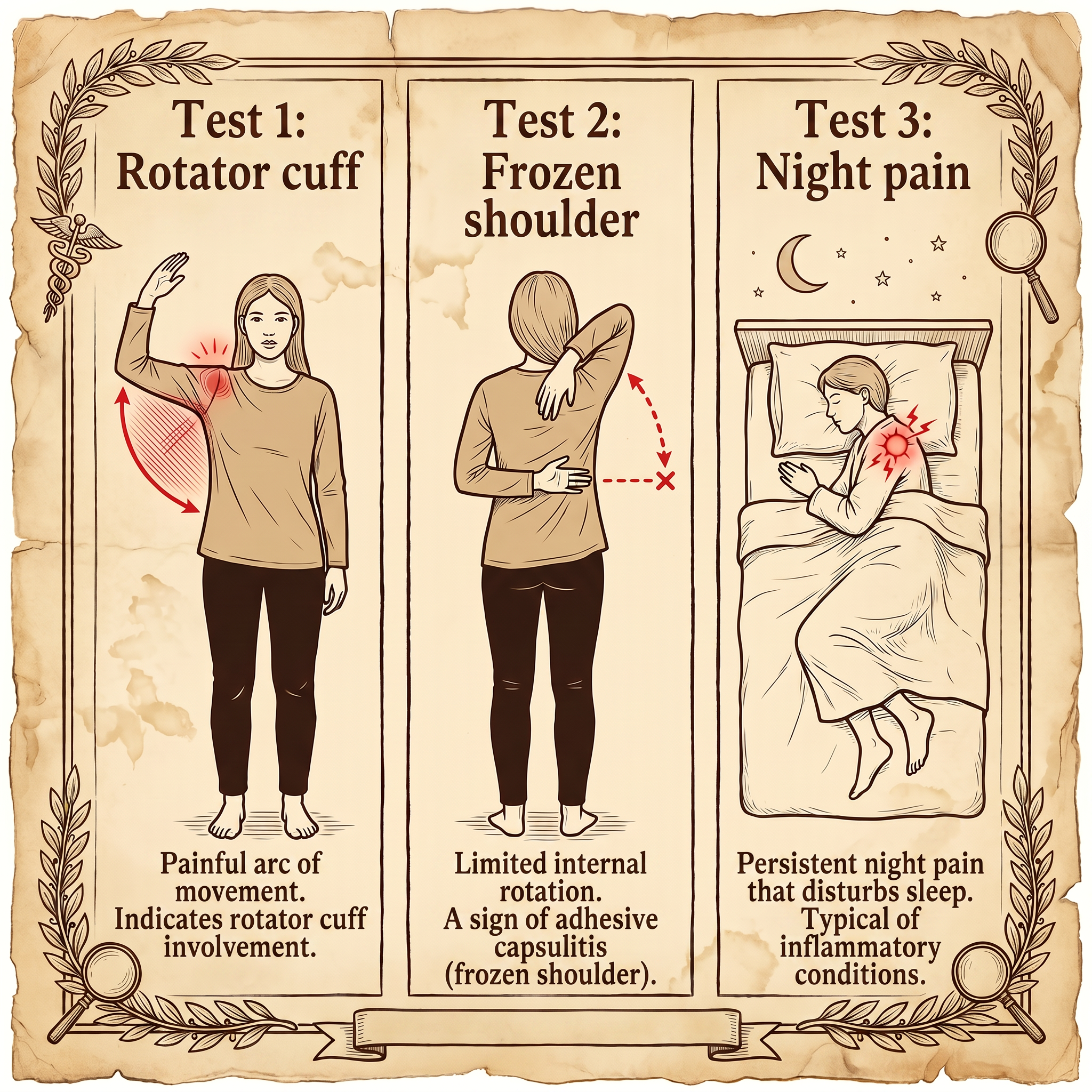
Here is what almost nobody explains: there are three standard orthopaedic tests that separate the main causes of shoulder pain, they take 30 seconds in total, and you can do all three at a mirror right now.
What is actually happening in your shoulder
The anatomy in 60 seconds
The shoulder trades stability for range. It is the most mobile joint in the body, and it pays for that by relying almost entirely on soft tissue to hold itself together: the four tendons of the rotator cuff, and the joint capsule that wraps the whole thing.
Both are built predominantly from collagen. Neither is muscle, which is why strengthening alone so often fails to fix a shoulder.
Why women after 45 in particular
Oestrogen influences the metabolism of connective tissue. As it declines through perimenopause and menopause, the body slows its production of its own collagen, and the capsule becomes stiffer and less elastic.
This is a large part of why adhesive capsulitis, the condition usually called frozen shoulder, appears disproportionately in women in exactly this age window, and why it is so often written off as ordinary ageing.
The three 30-second tests
Take 30 seconds. Not two days, not the next appointment. Each of these is a standard orthopaedic manoeuvre that doctors use in the clinic. Nobody just explains them to the patient.
Many women who run these three tests find they have a combination of causes rather than one. That is precisely why a single treatment aimed at a single structure so rarely resolves it completely.
Why the standard answers do not work after 45
Doctors working in public healthcare have a few minutes per patient and a waiting room behind them. The system hands them four tools, and none of the four addresses the raw material.
- Anti-inflammatories. They mask pain rather than change mechanics, and long-term use carries stomach, kidney and cardiovascular risk. There is also evidence that NSAIDs suppress collagen synthesis in tendon, meaning long-term use can work against the very tissue you are trying to repair.
- Cortisone injections. Six to eight weeks of relief, then the pain returns. Cortisone suppresses fibroblasts and collagen synthesis in the capsule, so after a second and third injection the capsule is weaker rather than stronger. This has been documented in the orthopaedic literature for decades.
- Physiotherapy alone. It genuinely helps mobility and muscular balance. But it does not deliver material for the tendon and capsule to rebuild with. It is sanding a wall without any plaster.
- Glucosamine and chondroitin capsules. The GAIT trial (NEJM 2006, PMID: 16495392) found no significant benefit over placebo in the overall population. A typical capsule also contains 500 to 750 mg of active ingredient.
Capsules contain milligrams. Tendon and joint capsule contain grams of collagen. The body wants raw material in grams, not milligrams. That is why the pharmacy aisle disappoints.
What the science says about collagen, oestrogen and the shoulder
Hydrolysed collagen and connective tissue
Hydrolysed collagen is pre-broken into short peptides, which makes it considerably more absorbable than ordinary gelatine. A 24-week trial in people with activity-related joint pain found collagen peptides improved symptoms compared with placebo (PMID: 18416885).
The variable that decides whether any of this matters is dose.
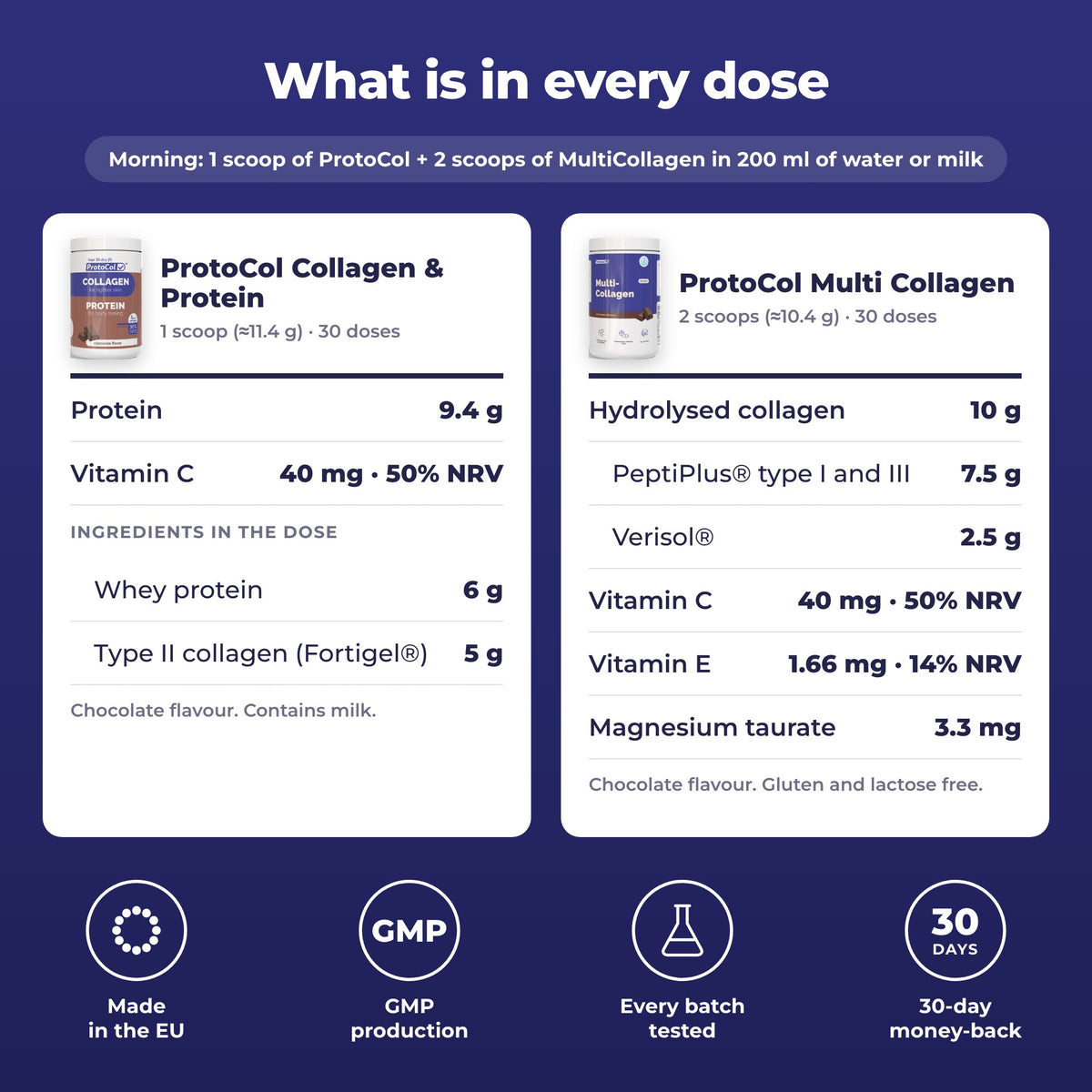
The full CollagenMax protocol delivers 15 g of hydrolysed collagen per day across the two jars: 5 g of Type II from the brown jar and 10 g of Type I and III from the blue one. This is the honest reason the protocol is two jars rather than one. A single jar is a smaller dose, and this article is about the amount actually studied for connective tissue.
Oestrogen, collagen and the joint capsule
The capsule is not inert. It remodels continuously, and that remodelling depends on available collagen. When production falls, remodelling shifts toward stiffness and fibrosis, which is the physical state a frozen shoulder is in.
You cannot restore oestrogen with a powder. You can supply the material the remodelling process is short of.
Vitamin C, the required cofactor
Vitamin C is required by the enzymes that stabilise the collagen triple helix. Without it, collagen fibres are formed defectively regardless of how much collagen you consume. Both jars carry 40 mg of vitamin C per dose, 50% of the reference intake, in the same scoop.
The protocol over 12 weeks
How to take it
Morning, the brown jar: one scoop, roughly 11 g, giving 6 g of whey protein and 5 g of hydrolysed collagen Type II, stirred into water. Evening, the blue jar: two scoops, roughly 10 g of hydrolysed collagen Type I and III, in a glass of water.
Not with boiling liquid. Every day, not most days.
What to expect
- Weeks 1 to 4. Little visible change in the shoulder. This is the loading phase and it is the point at which most people quit. Hair and nails often change first, simply because they turn over fastest.
- Weeks 5 to 8. Night pain usually softens first. Sleeping on the affected side becomes possible again for some people, and reaching behind the back extends a little.
- Weeks 9 to 12. Range of motion is where the change tends to show. Reaching a high shelf, fastening a seatbelt, putting on a coat without planning the movement first.
This is a rebuilding process, so it moves at the speed of tissue, not the speed of a painkiller. Anyone promising a shoulder back in a fortnight is selling something else.
What other women say
Three in the morning, every night, for over a year. That was the part that broke me. It was also the first thing that changed, somewhere in the second month.
I could not fasten my own bra. My husband did it. In the third month I did it myself without thinking, and then I stood there and thought about it.
Two cortisone injections. The first one was wonderful for six weeks. The second one did almost nothing, and that is when I started looking for something that rebuilds rather than quietens.
The seatbelt. Such a small thing to be defeated by every single morning. I reach for it normally now.
Notice that none of them describes a fast result. Every one describes months. That is what rebuilding connective tissue actually looks like.
Frequently asked questions
How long before I notice a change in the shoulder? The shoulder capsule is slow tissue. Most people report the first change in night pain between weeks 4 and 6, and improved reach between weeks 8 and 12.
Can I take it with my medication? Collagen and whey protein are generally well tolerated. If you take prescription medication or have any chronic condition, speak to your doctor before starting. This is a food supplement, not a medicine.
Is it suitable if I have autoimmune or rheumatoid arthritis? Collagen and protein are foods rather than immune modulators, but inflammatory arthritis needs medical management. Speak to your rheumatologist and treat this as nutritional support alongside your treatment, not instead of it.
What does it taste like and how is it prepared? Both jars are chocolate flavoured and sweetened with stevia, sugar-free and gluten-free. Stir into water or another cool liquid, never boiling.
Is it vegan? No. Collagen is by definition an animal protein and the collagen here is bovine. The brown jar also contains milk, as whey protein.
What if I have a kidney condition or diabetes? Collagen is a concentrated protein, so if you have kidney disease speak to your doctor or nephrologist before starting. If you have diabetes, discuss it with the doctor who manages your care. We are not in a position to give dosing advice for a medical condition.
What happens if I stop after three months? Rebuilt tissue does not vanish, but the underlying decline in your own collagen production continues, so most people carry on at a lower maintenance intake.
Is there a guarantee if it does not work for me? Yes, 30 days, money back.
When to see a doctor
Three tests at a mirror are a starting point, not a diagnosis. Some shoulder presentations need a clinician rather than a supplement.
What to do now
To summarise: shoulder pain that wakes you at night, blocks you from reaching behind your back, and has been labelled wear and tear is very often a collagen problem in the rotator cuff tendons and the joint capsule, not a muscle problem and not simply age.
The three tests tell you which pattern you have. The answer to the underlying material shortage is the same in each case: collagen in gram quantities, vitamin C so it can actually be assembled, and protein so the muscles around the joint share the load.
The CollagenMax protocol delivers 15 g of hydrolysed collagen a day across the two jars, with 40 mg of vitamin C, and comes with a 30-day money-back guarantee.