


There is one question that decides most cases of chronic lower back pain in women over 40, and almost nobody is asked it in a ten-minute appointment.
The question is: where does the pain stop?
Not how bad it is. Not how long you have had it. Where it stops.
Answer that accurately and you can tell, in about five seconds and without a referral, whether what you have is sciatica or something quite different that standard scans routinely miss.
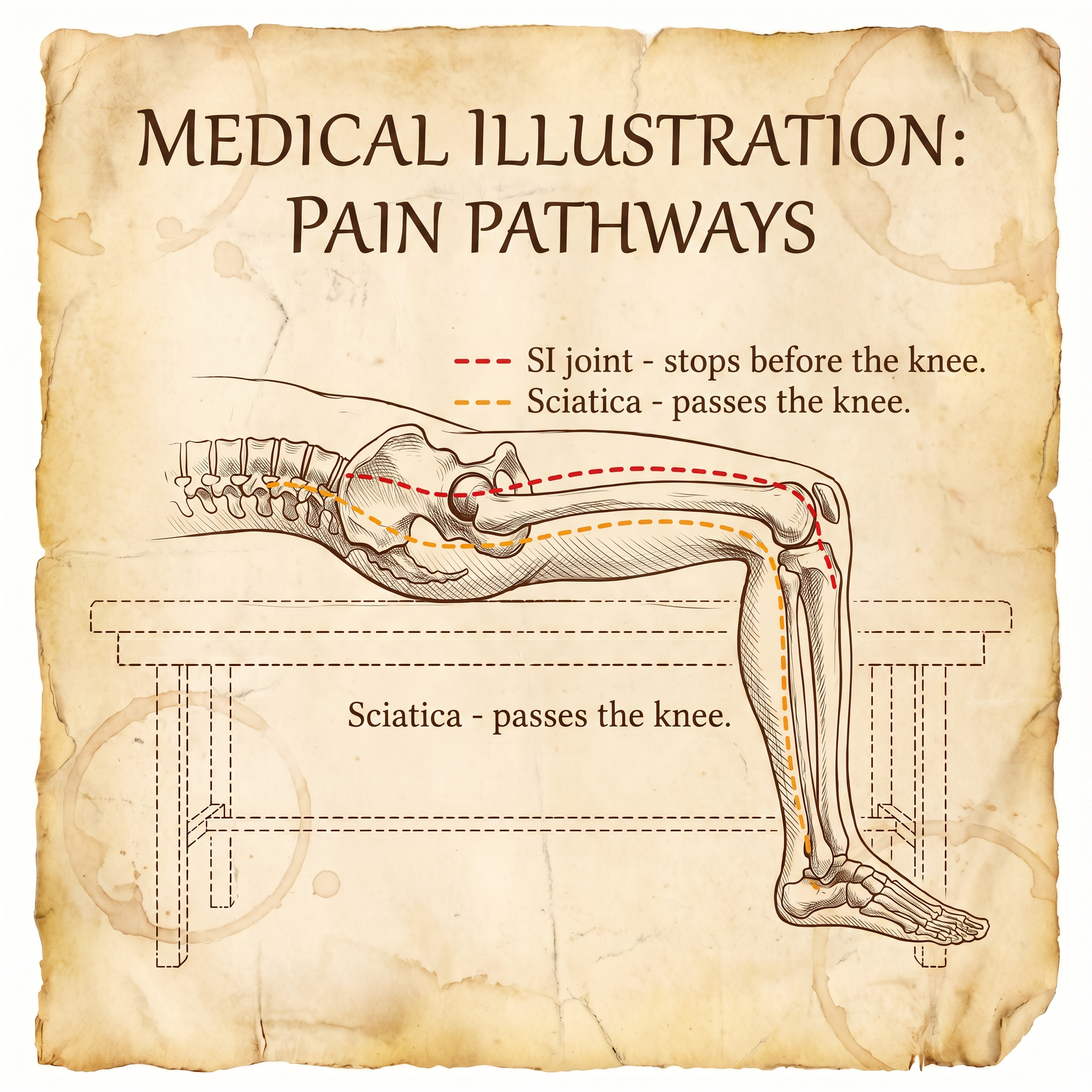
The 5-second test: where does the pain stop?
Lie on your back on the bed or the sofa. Find the point where the pain begins. That is usually the lower back or the buttock.
Now trace with a finger where it travels. Start at that point and move down the thigh, along the back or the outer side.
Then ask yourself: where does it stop?
The four movements that give the SI joint away
The sacroiliac joint has a signature. Pain from it worsens on very specific movements, while the same movements are often unremarkable with sciatica.
If you answered yes to three or four, the probability that this is sacroiliac dysfunction rather than sciatica is high.
Remember that. Because what follows explains why the standard examination does not catch it.
Why the doctor says it is just your age
Sacroiliac dysfunction is one of the most commonly misdiagnosed conditions in women over 50. Not because doctors are incompetent, but because the standard examination is not built to find it.
Why X-ray and MRI miss it
An X-ray shows bone. An MRI shows discs, bone and nerve roots. Both are excellent at finding herniations, spinal stenosis and fractures.
But sacroiliac dysfunction is a soft-tissue problem, specifically of the ligaments that hold the joint stable. On an X-ray the joint looks entirely normal. On an MRI it looks normal too. And when the images come back clean, the conclusion is standard: no structural damage, probably muscular.
A review in Pain Medicine (Cohen SP, 2005, PMID: 16266355) puts it plainly: 15 to 30% of chronic low back pain originates in the sacroiliac joint. That is roughly every third or fourth case walking into an orthopaedic clinic, carrying a problem that will not appear on the standard images.
Why the provocative tests are rarely done
There are specific tests that reproduce SI joint pain accurately. Gaenslen's test. The FABER test. Pelvic compression. A doctor who suspects SI dysfunction applies pressure at particular points and asks: does this reproduce your pain?
Those tests take five to seven minutes. A typical appointment runs five to ten minutes in total. The arithmetic does not work, so the provocative tests are rarely done, and the default diagnosis stays lumbago, sciatica, or hormones.
Why the standard treatments only half work
When the diagnosis is imprecise, the treatment is imprecise too.
- Anti-inflammatories reduce inflammation and the pain recedes for six to eight hours. When the effect wears off it returns, because the cause was never addressed. Long-term use loads the stomach, the kidneys and the cardiovascular system.
- Generic glute and core physiotherapy strengthens muscle. Strong muscles help, but they cannot on their own stabilise a ligament that has weakened. It is like repairing a house with failing foundations by painting the walls.
- Cortisone injections give dramatic relief for three to six weeks. Repeated long-term injections can further weaken connective tissue, which is a well-documented effect.
The doctor who does not know about SI dysfunction says it is normal at your age. In fact there is a precise cause and a precise sequence that addresses it. The cause is not where most people look, and the answer is not on the pharmacy shelf.
What is actually happening in the SI joint
This part gets technical, but it matters. Once you understand the mechanism, you understand why capsules from the pharmacy were never going to be the answer.
The sacroiliac joint is a shock absorber that barely moves
The SI joint connects the sacrum to the pelvis. Unlike the knee or the shoulder, it is not built for range of motion. It moves only a few millimetres. Its job is to transfer the load of the entire upper body into the legs, and to absorb shock while doing it.
What holds it stable is not muscle. It is a dense network of ligaments, and ligaments are built predominantly from collagen.
What weakens them
Two things, and they compound.
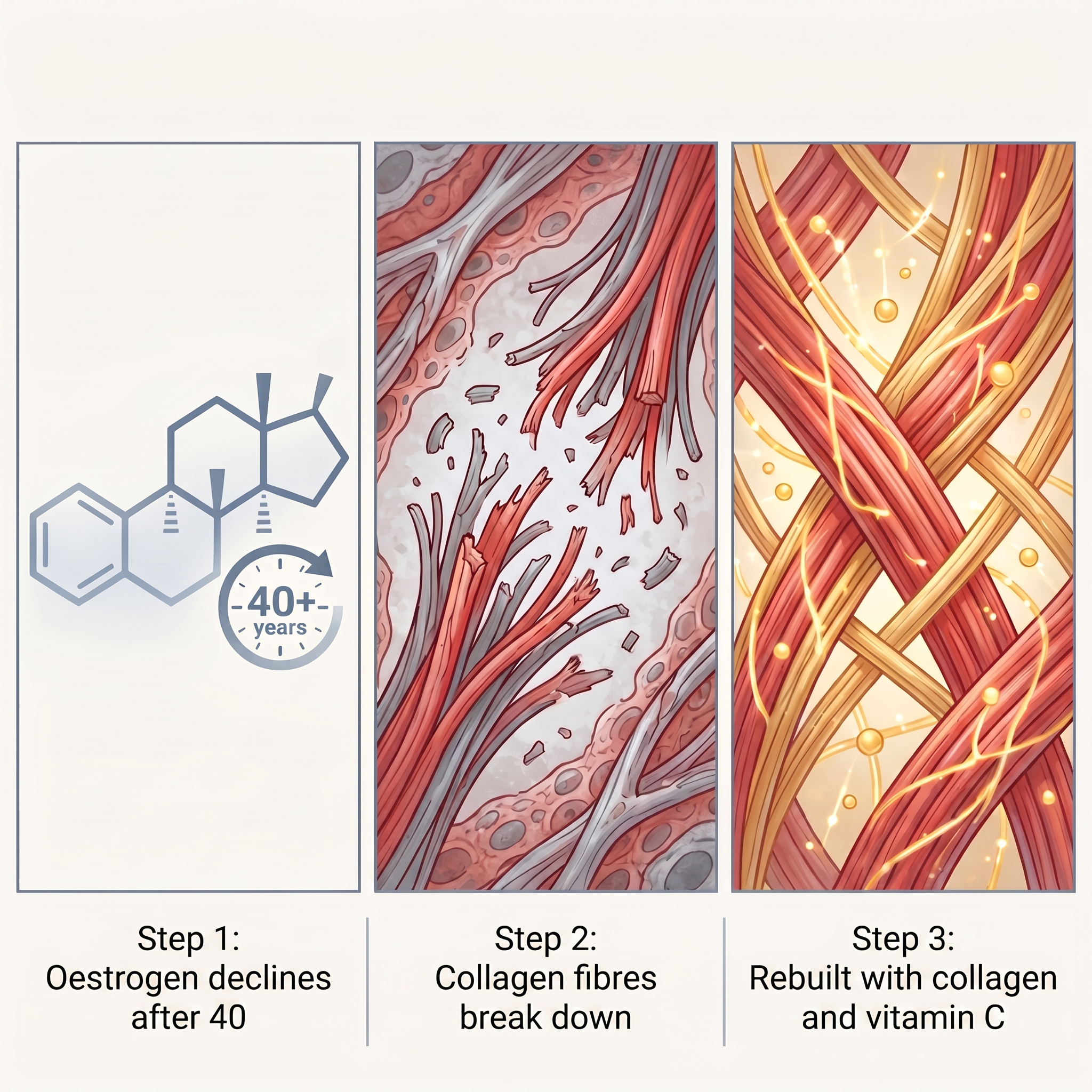
The first is time. From around the age of 40 the body slows its production of its own collagen. Ligaments become stiffer and less resilient, and repair more slowly after everyday micro-damage.
The second is hormonal. Oestrogen influences the metabolism of connective tissue, and through perimenopause and menopause its decline is not gradual but abrupt. This is a large part of why sacroiliac pain appears so often in women in exactly this window, and why it is so often misattributed to age alone.
When the ligaments loosen, the joint moves fractionally more than it should. That extra movement irritates the surrounding tissue, the surrounding muscles tighten to compensate, and the result is a pain that is sharp, one-sided, worse on rotation, and stubbornly resistant to everything aimed at muscle.
Why painkillers are never the answer
A painkiller works on the signal. It does nothing to the ligament. The alarm goes quiet while the situation underneath is unchanged, and the daily cost accumulates in the stomach and the kidneys.
If the ligament is short of the material it is made from, the only thing that changes the trajectory is supplying that material.
What works: the three ingredients
Hydrolysed collagen, the raw material
Ligaments are collagen. Hydrolysed collagen is pre-broken into short peptides, which makes it far more absorbable than ordinary gelatine, and studies show those peptides reaching connective tissue rather than simply being burned as protein.
A 24-week trial in people with activity-related joint pain found collagen peptides improved symptoms compared with placebo (PMID: 18416885).
Here is where most people get it wrong, and it is a question of dose.
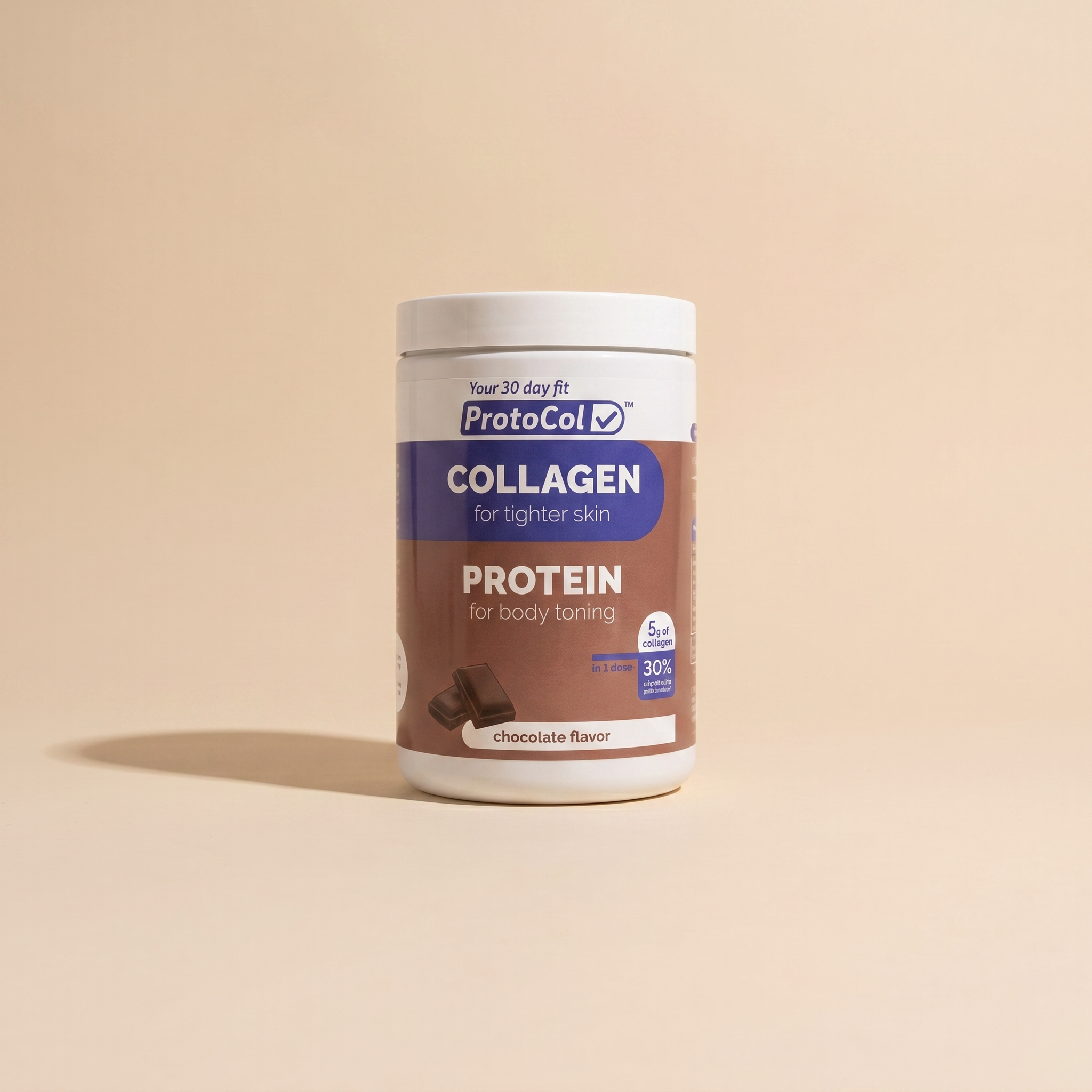
The brown jar delivers 5 g of hydrolysed bovine collagen Type II (Fortigel) per scoop, alongside 6 g of whey protein, for 11 g of total protein. Grams, not milligrams. It is worth being precise about this, because the supplement aisle is not: a great deal of collagen marketing quotes milligrams in bold precisely because the number looks larger.
Vitamin C, the cofactor
There is one nutrient without which the body physically cannot assemble collagen fibres. Vitamin C is required by the enzymes that stabilise the collagen triple helix, which is why a deficiency produces fragile, failing connective tissue.
You can take collagen by the sackful. Without vitamin C, synthesis stops. The brown jar carries 40 mg of vitamin C per dose, 50% of the reference intake, in the same scoop rather than as a separate pill you will forget.
Whey protein, the muscle frame
Collagen rebuilds the ligament. Protein maintains the muscle that shares the load with it.
Weak muscle around the pelvis means the entire load lands on a joint that is already irritated. The 6 g of whey in each scoop feeds the muscles that carry the pelvis, so the joint is not left doing the work alone. This is why the formula is collagen and protein rather than collagen alone.
The protocol in practice
How to take it
One scoop, in the morning, stirred into a glass of water. It is chocolate flavoured, sugar-free and gluten-free, and dissolves in about 15 seconds. Do not mix it with boiling liquid.
Take it every day. Connective tissue rebuilds on its own schedule, and the women who see a result are the ones who took it for months rather than days.
Week by week
- Weeks 1 to 2: Little obvious change. Some people notice hair and nails first, which is normal, since those turn over fastest.
- Weeks 3 to 4: Getting out of the car and out of bed becomes easier. The sharp catch on turning over at night starts to soften.
- Weeks 8 to 12: The one-sided ache quietens. Stairs stop being negotiated one at a time. This is the window in which most people say it finally shifted.
What women who went through it say
I was told it was sciatica for two years. The pain never went past my knee, not once. I started the powder in October and by the sixth week I could get out of the car without bracing against the door.
Turning over in bed was the worst part. That sharp catch that wakes you. It is the thing that faded first, somewhere around the fourth week.
Three rounds of physiotherapy, and it helped while I was doing it and came back after. Nobody mentioned the ligament once.
The stairs. I used to take them one at a time and pretend I was in no hurry. Now I just go up them.
Notice what none of them describe. Not one talks about an overnight change. Every one talks about weeks. That is the difference between rebuilding tissue and muting a signal.
Frequently asked questions
How long before I feel a difference? Most people notice the first changes between weeks 3 and 4, usually getting out of bed and out of the car more easily. Connective tissue turns over slowly, so the deeper change tends to arrive between weeks 8 and 12. Consistency matters more than dose.
Is it safe alongside my other medication? Collagen and whey protein are generally well tolerated. If you have a chronic condition or take prescription medication, speak to your doctor before starting. This is a food supplement, not a medicine.
Can I take it with coffee or tea? Yes, but not with boiling liquid. Heat above roughly 60 degrees can denature the protein. Let a hot drink cool first, or simply use water.
Why do pharmacy collagen capsules not give the same effect? Dose. A typical capsule delivers 500 to 2,000 mg of collagen per day. The research on connective tissue works in grams. One scoop of the brown jar gives 5 g of hydrolysed collagen Type II plus 6 g of whey protein. Many cheaper formulas also omit vitamin C, without which new collagen cannot be formed at all.
Is there a vegan version? No. Collagen is by definition an animal protein, and the collagen here is bovine. There is no plant source of true collagen. Plant products marketed as vegan collagen are collagen boosters, meaning vitamins and amino acids, not collagen itself.
What if I already have a diagnosed disc herniation? A herniation and sacroiliac dysfunction can coexist, and often do. Supporting connective tissue does not treat a herniation. If you have a confirmed herniation with nerve involvement, follow your specialist's plan and treat this as support, not as a replacement.
How does the 30-day guarantee work? Take it for 30 days as directed. If you feel no difference, contact us and get your money back.
When the pain is a signal for something serious
Most lower back pain in this age group is mechanical. Some is not, and the difference matters.
These can indicate nerve compression, infection, fracture or other conditions that need a diagnosis rather than a supplement. Rule the serious causes out first. For everything else, for the one-sided ache that stops before the knee, the material the ligament is made from is the logical next step.
What to do now
To summarise: if the pain stops before the knee, worsens when you turn over in bed and when you get out of the car, and the scans came back clean, the most likely explanation is not sciatica and not simply your age. It is a sacroiliac joint whose ligaments have lost collagen.
Ligaments are collagen. Collagen needs vitamin C to be built, and the muscle around the joint needs protein to share the load. That is the whole logic, and it is why the formula contains those three things and not a longer list.
ProtoCol Collagen and Protein delivers 11 g of total protein per scoop, 6 g of whey plus 5 g of hydrolysed collagen Type II, with 40 mg of vitamin C. One scoop each morning, in water. With a 30-day money-back guarantee, so the only thing you risk is the time it takes to find out.


