You know exactly which moment this is about.
The first 30 minutes after you open your eyes. The clock says 6:10. The house is quiet. And you lie there gathering the courage to stand up, because you already know the first step is going to hurt.

You take hold of the edge of the nightstand. You lower yourself down slowly. The hip stabs, the knee complains, the shoulders feel glued in place. You walk to the bathroom like a woman twice your age. And as the water runs, the body slowly thaws.
Then you call your daughter and say: "I'm fine."
You have not told anyone how heavy those first 30 minutes are. You have filed it away. You have called it getting older and carried on. Perhaps because your mother had the same thing. Perhaps because you are certain what the doctor will say: at your age, that is normal.
But here is what almost nobody tells you: the first 30 minutes of the morning are not a verdict. They are a diagnostic window. And what you have been told about the cause is very often wrong.
In the lines that follow, a rehabilitation specialist explains what is actually happening in your body in the morning, why the X-ray comes back clean while you feel terrible, and how one simple 30-second test can tell you more than three appointments.
What is actually happening in your body in the morning
To understand why mornings hurt most, you have to look at the soft tissue, not the bones.
The night thickens the joint's lubricant
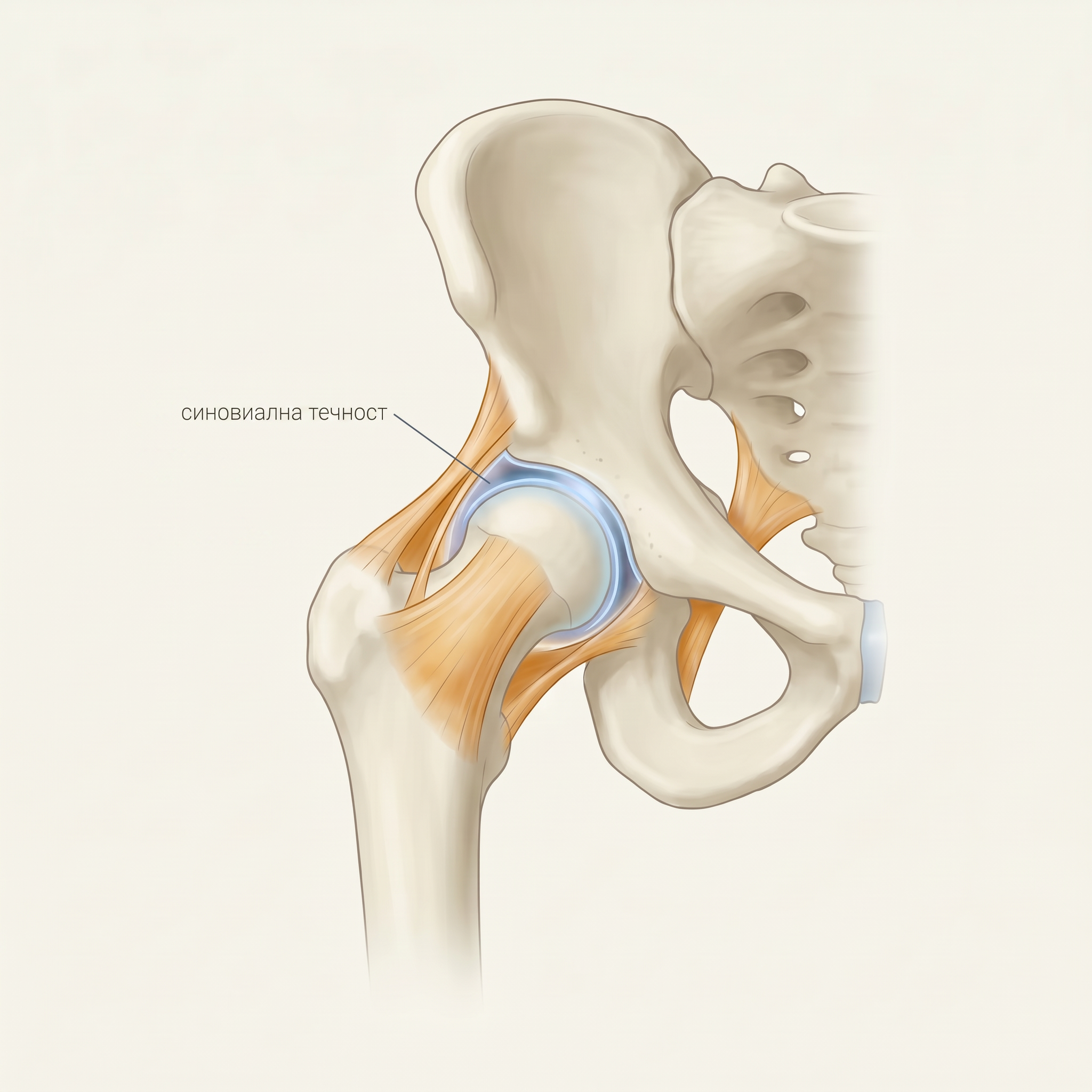
Your joints move smoothly thanks to synovial fluid, the body's own lubricating oil between the bones. During the day, while you move, it stays fluid and well distributed. At night, when you lie still for hours, that fluid thickens and the tissues around the joint begin to stick.
That is why the first movements of the morning are so heavy, and why after 20 or 30 minutes of moving around things loosen up. It is not random. It is mechanics.
After 40, the collagen in tendons declines
Here comes the second and more important layer. Tendons, ligaments and the joint capsule are built mostly from collagen, the protein that gives them strength and elasticity at the same time. After the age of 40, and especially as menopause arrives, oestrogen falls, and with it the body sharply slows its production of its own collagen.
The result: tendons become stiffer and more brittle, inflame more easily and recover more slowly. Every movement leaves micro-tears that the body no longer patches up in time.
In women this decline is abrupt. Joint pain is one of the most commonly reported complaints through perimenopause, and most women are handed the label of arthritis without anyone mentioning collagen or hormones. The problem is not in the bones. The problem is in what sits between them.
The cascade: why the pain travels from hip to shoulder
You may have noticed something that makes no sense: it started in the hip. Then the knees spoke up. And now the shoulders are stiff every morning too.
That is not a coincidence. That is a cascade.
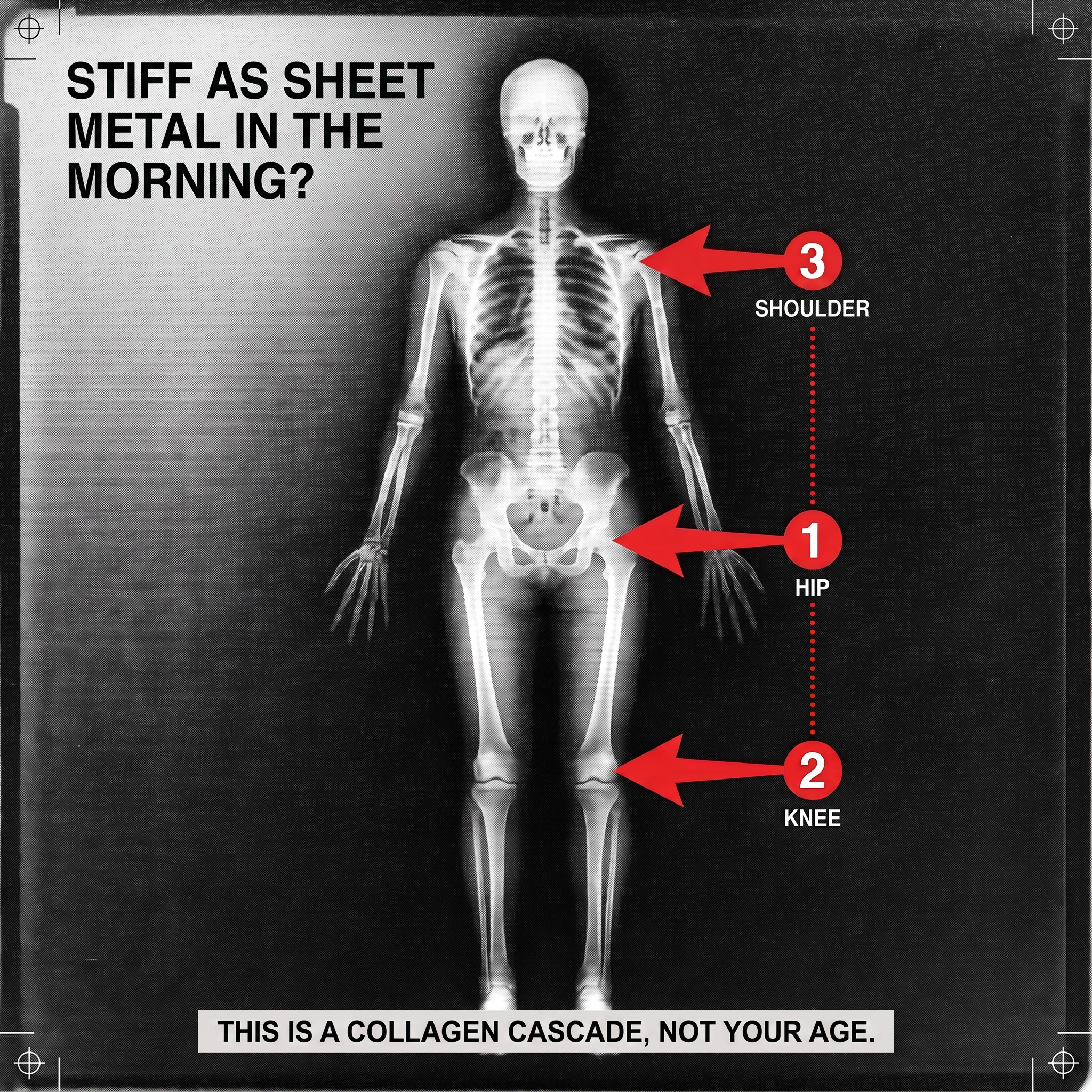
Picture it as falling dominoes:
- Domino 1: The tendons in the hip weaken first, as the most loaded area after 40.
- Domino 2: The knee ligaments start compensating for the load, and wear down in their turn.
- Domino 3: The shoulders and neck absorb the remaining tension and stiffen.
Doctors look at each joint separately, one referral for the hip, another for the knee, a third for the shoulder. And they miss the shared cause: a systemic decline in collagen that hits every tendon at once, simply in a different order.
It is not arthritis in three different places. It is one cause showing up in three places.
That is why treating one joint never solves the problem. You put out the fire in one corner while it is already burning in the next.
Why the standard answers do not work
If you have already tried something, or been offered something, it was probably one of these. Here is why none of them reach the cause.
Painkillers and anti-inflammatories. They mute the pain signal for a few hours. But a silenced alarm does not mean the fire is out. While you feel better, the tendons carry on quietly breaking down. And with daily use there is a second price: a damaged stomach.
Cortisone injections. They give temporary relief, then the pain returns, often stronger. Cortisone manages inflammation, but it does not build tissue. And the problem is precisely a shortage of building material.
Pharmacy collagen capsules. This is the most common mistake. Most capsules deliver 500 to 2,000 mg of collagen per dose. That sounds like a lot until you realise the body needs grams, not milligrams. Milligrams are a drop in the ocean for tissue that has to be rebuilt over months.
Stretching alone, or "rest more". Movement matters, but you cannot build a tendon without raw material. Stretching tissue that is short of collagen sometimes makes things worse.
And then comes the sentence every woman has heard:
At your age that is normal. Have you considered yoga?
The doctor is not a bad person. The system gives them 10 minutes per patient and trains them to read the bones on the scan, not the soft tissue the scan does not show. So the X-ray comes back clean, and you are left with the pain and the feeling that nobody is listening.
What the science says (and why grams matter)
Let us set the promises aside and look at what the research on collagen and connective tissue actually shows.
Collagen is not "just for skin"
Specific hydrolysed collagen peptides have been studied for years for ligaments, tendons and cartilage, not only for skin. Studies show that taking collagen peptides improved symptoms in people with activity-related joint pain (PMID: 18416885). Other data indicate that collagen peptides accumulate in cartilage and stimulate the cells there to produce more of their own matrix (PMID: 22521757).
In postmenopausal women, specific peptides also showed an effect on bone density in a 12-month randomised trial (PMID: 29337906). And adequate protein intake is central to the muscles around the joint, the frame that absorbs load instead of letting it fall directly onto the joint itself.
Why milligrams are not enough
The decisive difference is the dose. The studies that show an effect on connective tissue use grams of collagen per day, typically between 5 and 15 g depending on the goal. That is why pharmacy mono-collagens at 500 mg so often disappoint: their dose sits tens of times below the researched one.
Vitamin C, the cofactor without which nothing happens
There is one cofactor without which the body physically cannot build collagen fibres: vitamin C. It is required by the enzymes (prolyl and lysyl hydroxylase) that stabilise collagen fibres, which is also why a vitamin C deficiency leads to fragile, failing collagen. You could take collagen by the sackful, but without vitamin C the synthesis stops. That is why a good formula always pairs collagen with vitamin C rather than relying on the powder alone.
The natural approach: the active ingredients and the mechanism
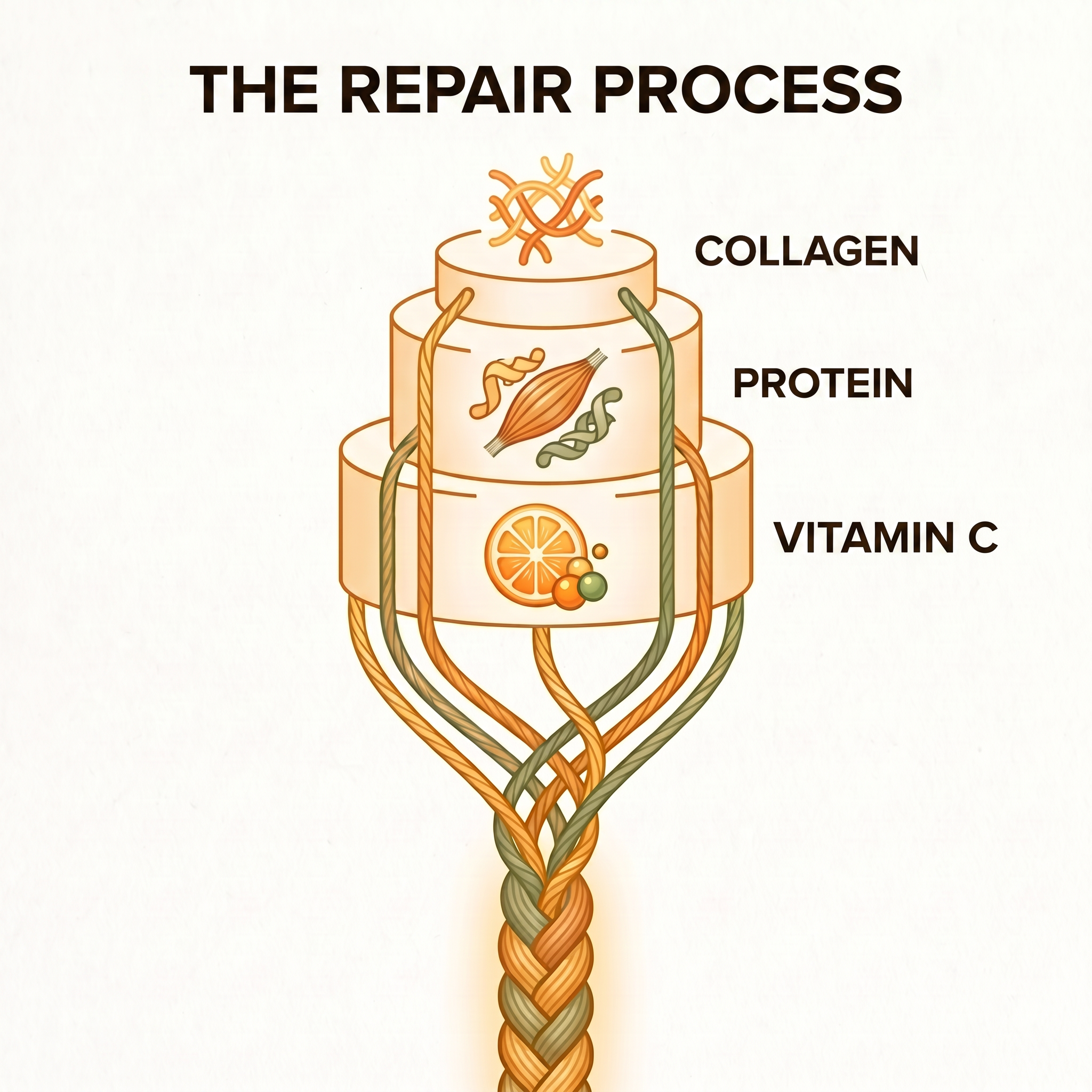
If the problem is a decline in collagen that hits the tendons, the muscle frame and synthesis at the same time, then the answer has to address all three levels at once. Here is the logic specialists use.
Level 1: the building material, hydrolysed collagen
First you need the raw material for the tissue itself. Hydrolysed collagen is pre-broken into small peptides, which makes it far more absorbable than ordinary gelatine. Type I supports tendons and fascia, Type II is directed at joint cartilage, and Type III at the joint capsule and connective tissue. These are the tissues that gel overnight.
Level 2: the muscle frame, protein
Collagen alone is not enough. Weak muscles mean the entire load falls directly onto the joint. Whey protein feeds the muscles around the hips, knees and back so that they carry the load, and the joints do not wake up rusted from compensating. That is why protein is a central part of the protocol rather than an afterthought.
Level 3: the cofactor, vitamin C
And finally vitamin C, which unlocks the whole process. Without it, the collagen you take does not become real new fibres. It is the quiet hero of the formula.
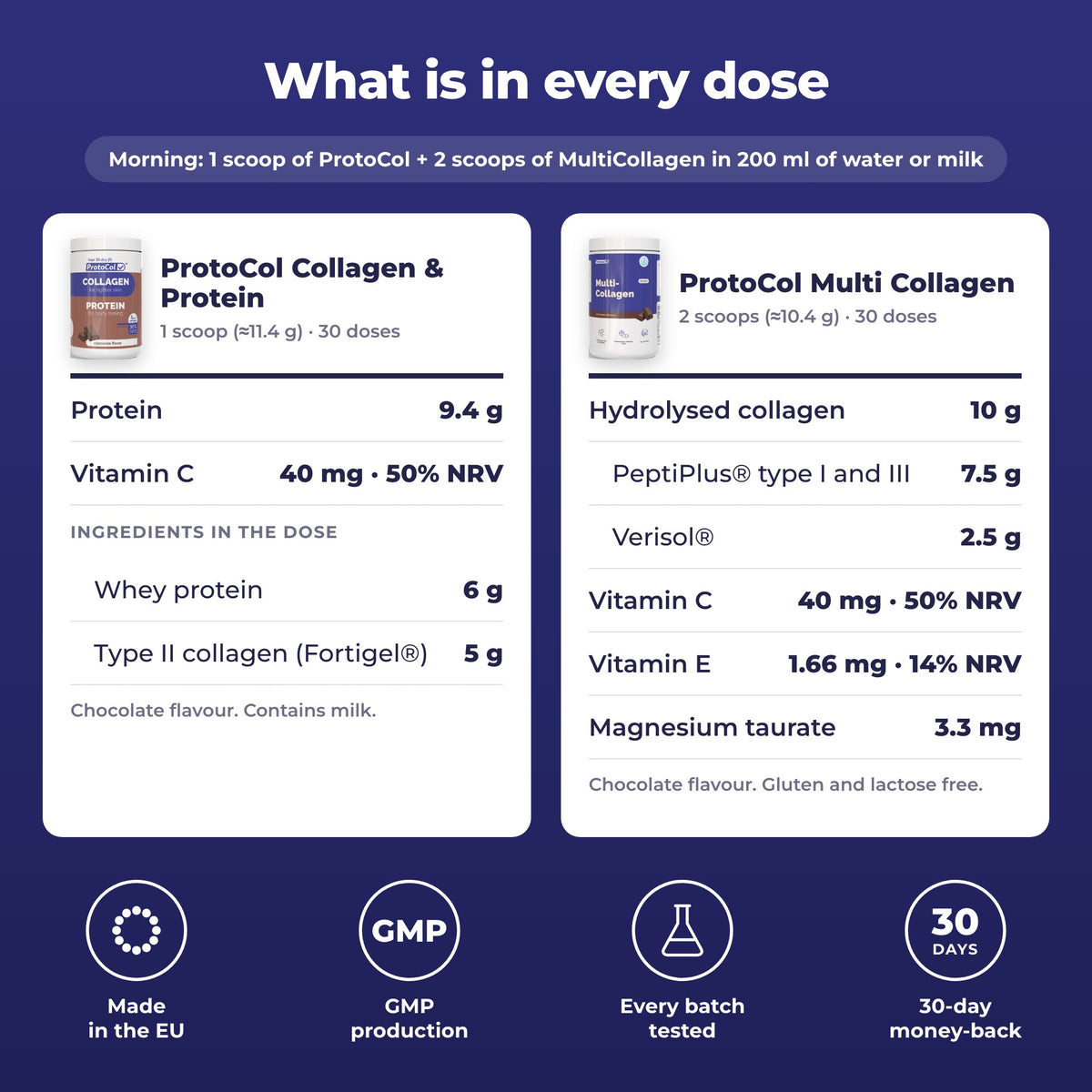
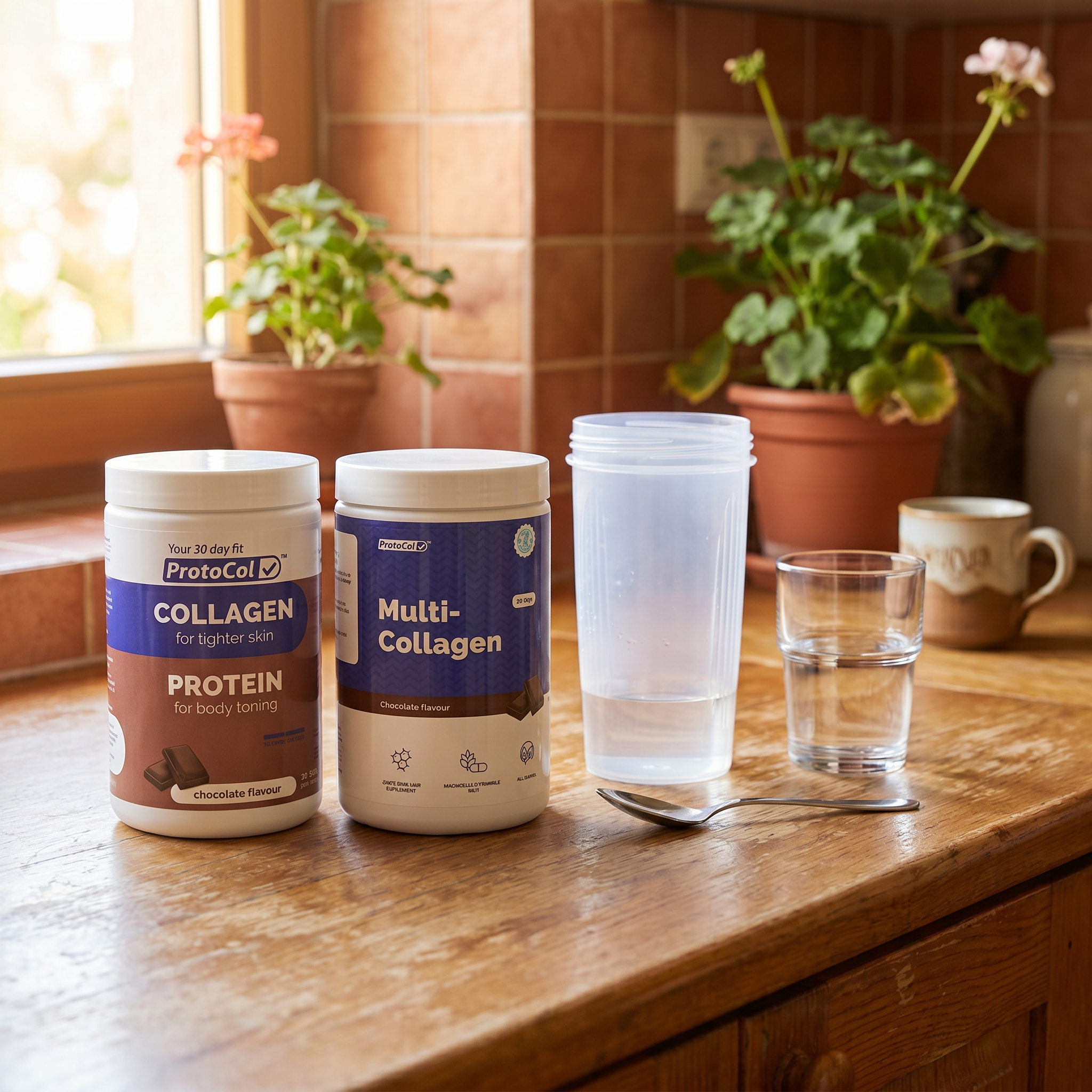
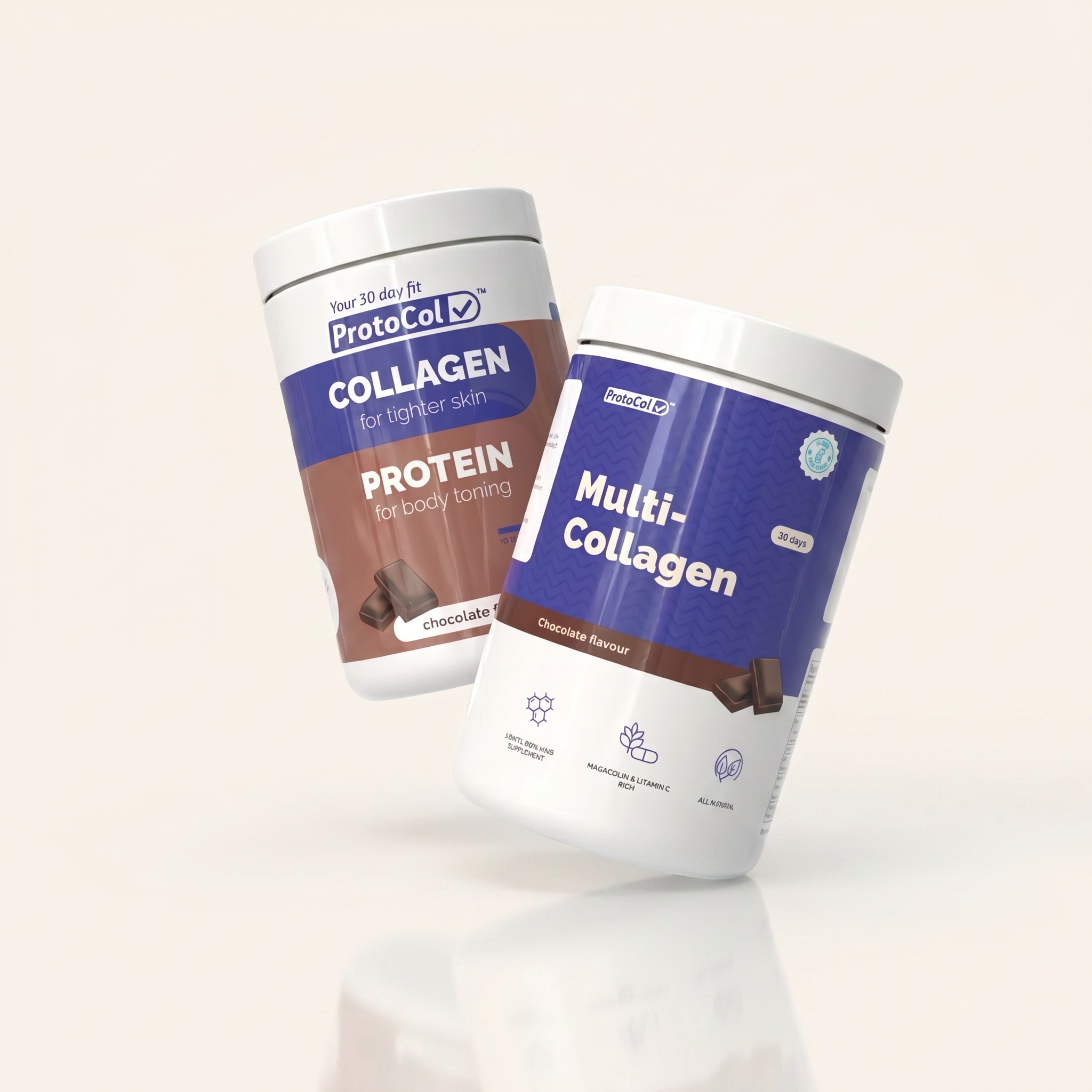
This triple logic is exactly what sits behind Protocol's CollagenMax system: two jars that work together, the brown one (Type II collagen plus whey protein, the morning dose for strength and muscular support) and the blue one (multi-collagen Type I and III, for the elasticity of connective tissue). Not one more pill, but building material in amounts the body can actually use.
The protocol in practice: what to expect week by week
Genuinely rebuilding tissue takes time. This is not a patch over the pain, it is a reconstruction phase. Here is the realistic picture.
How to take it
Morning, the brown jar (Type II collagen plus protein): 1 scoop (about 11 g), stirred into water or another liquid. It gives muscular support for the day. Evening, the blue jar (multi-collagen): 2 scoops (about 10 g), dissolved in a glass of water, for the elasticity of connective tissue overnight, while the body recovers.
Take it daily. Consistency is everything. The women who see a result take it for months, not days.
The timeline most women describe
- Weeks 1 to 2: Less clicking in the joints. Hair and nails feel stronger. Getting out of bed becomes a little easier.
- Weeks 3 to 4: Morning stiffness noticeably reduces. You stop bracing before every movement. The first 30 minutes are no longer an ordeal.
- Weeks 8 to 12: The deep ache quietens. You go down the stairs without holding the rail. You sleep on your side all night.
In the second month I got out of bed and walked to the bathroom, and only at the mirror did I remember that I was supposed to be wincing. The first 30 minutes had evaporated.
This is the moment women describe not as "30% better" but as feeling like themselves again.
The 30-second test you can do yourself (no doctor needed)
Here is the window we mentioned at the start. Do this test tomorrow morning. Nobody needs to know, you need no referral and no appointment.
Doctors rarely make that distinction in 10 minutes. But your own body tells you every morning. You only have to listen to it.
If you are in the first group, you were not imagining it and you are not a hypochondriac. You have a specific, explainable cause, and it has an answer.
What people say

The first month, nothing much. In the second I got out of bed and walked to the bathroom, and only at the mirror did I remember I was supposed to be wincing. The first 30 minutes had evaporated.
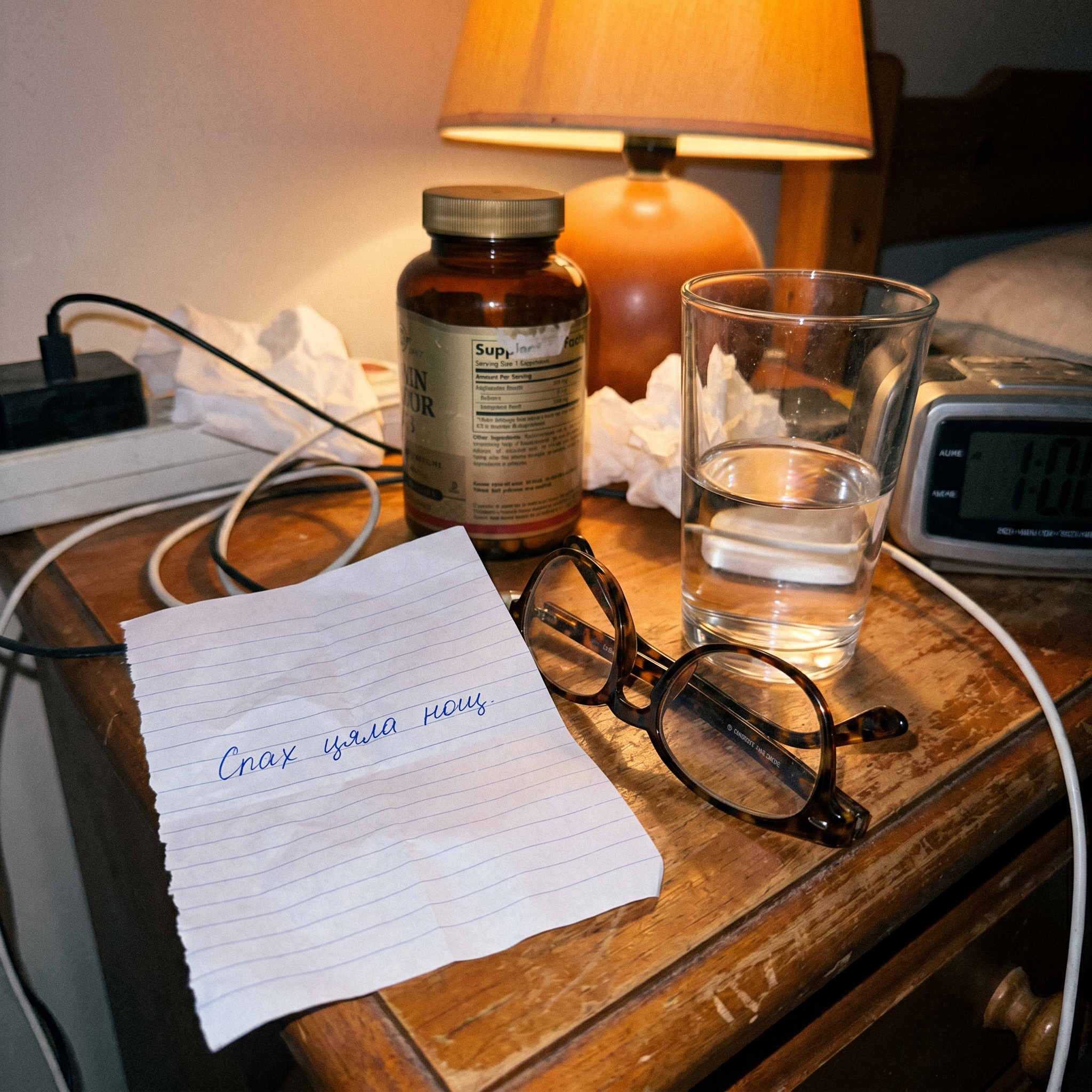
I went through three different pharmacy collagen brands in two years, all in blue and white boxes. Nothing. With Protocol, in the sixth week, I started going down the stairs without holding the rail.
I felt like sheet metal. Every morning I had to oil the hinges. Now, in the fourth month, I get up and simply go. Without that 30-minute ritual.
Notice what these women do not say. Not one of them talks about an overnight miracle. Each talks about consistency and about weeks. That is precisely the difference between a real building process and one more promise.
Frequently asked questions

How quickly will I feel a difference? Most people report the first changes between weeks 2 and 4 (less clicking, getting up more easily), with the deeper change arriving between weeks 8 and 12. This is a building process, not a painkiller, so consistency is what decides the outcome.
Does it contain sugar or gluten? The formula is sugar-free and gluten-free, sweetened with stevia. The brown jar contains milk (whey protein), which matters if you have a dairy protein allergy.
What is the actual collagen dose? The brown jar gives 11 g of total protein per dose (6 g whey protein plus 5 g hydrolysed bovine collagen Type II) plus 40 mg of vitamin C. The blue jar gives 10 g of hydrolysed collagen (Type I and III) per dose. Real grams, not milligrams.
Is it for men or for women? Both. The decline in collagen after 40 affects everyone, though in women going through menopause it is sharper. The mechanism, meaning tendons, the muscle frame and synthesis, is the same.
Can I take it alongside other medication? Collagen and protein are generally well tolerated, but if you have a chronic condition or take prescription medication, speak to your doctor before starting. This is a food supplement, not a medicine.
How do I take it, with food or on an empty stomach? Stir it into water or another liquid. Brown jar in the morning, blue jar in the evening. It dissolves easily and should not be mixed with boiling water.
What if it does not work for me? There is a 30-day money-back guarantee. Finish the jars and give it a fair chance. If you feel no difference, send it back and get your money returned.
When to see a doctor
This protocol is for the most common case, mechanical soft-tissue stiffness. But there are situations where you need a doctor, not a supplement.
These signs can indicate an inflammatory or other condition that needs a medical diagnosis. The responsible move is always to rule out the serious causes first. For everything else, for the mechanical stiffness that eases once you get going, building material is the logical next step.
What to do now
In summary: morning stiffness that passes in under 30 minutes is rarely "your age" and rarely arthritis. It is mechanical, thickened joint fluid plus tendons short of collagen. The answer works on three levels at once: collagen for the tissue, protein for the muscle frame, vitamin C for synthesis.
Every day you wait, the cascade continues, hip, knee, shoulder, one after another. And recovery is easier now than it will be after another two years of reaching for the nightstand.
Protocol's CollagenMax system combines both jars into one protocol. The pack currently also includes a FREE D3+K2+Q10 gift worth 20 EUR, which is 96.95 EUR of value for 56.00 EUR. With a 30-day guarantee: try it without risk, and if you feel no difference, get your money back.