The report says nothing is wrong. Your knees disagree.
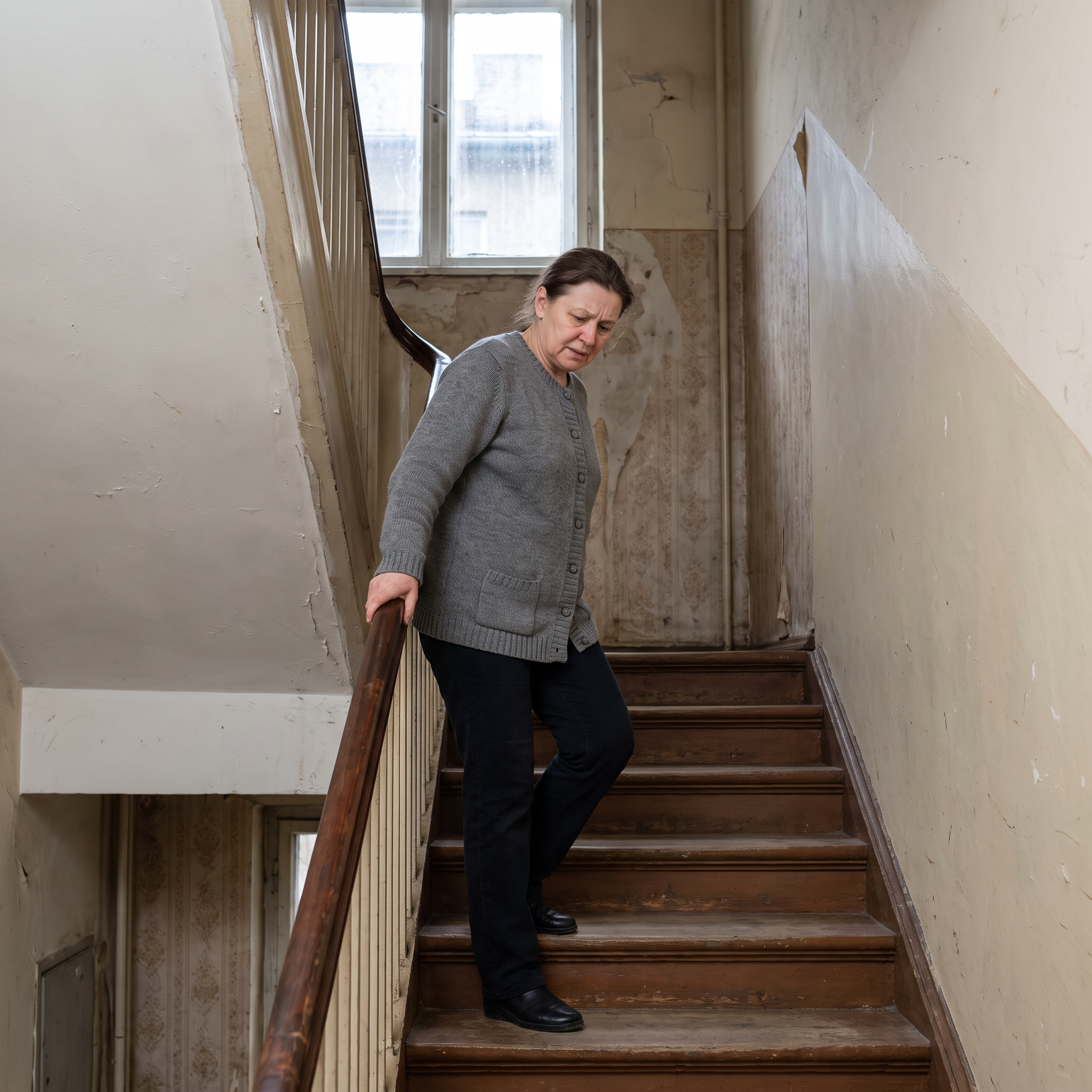
You know the exact moment. Not the walk to the shops, not the standing. The stairs.
Going up is manageable. Coming down is the problem. That first step where you have to let your body weight drop onto one leg, and the knee gives a short, sharp complaint. So your hand finds the handrail without you deciding to reach for it. You go down slightly sideways. You have been doing it for months and you stopped noticing when it started.
Eventually you went to the doctor. They sent you for an X-ray. And the result came back: normal for your age.
You went home with nothing. No diagnosis, no explanation, and the quiet suggestion that you should probably lose a few kilos and not overdo it. Meanwhile the stairs still hurt.
Here is the part nobody explained to you: a normal X-ray does not mean nothing is wrong. It means nothing is wrong with your bones. And in a knee that hurts on the stairs after 40, the bone is almost never the thing that failed first.
What an X-ray can and cannot see
A radiograph is a shadow picture of density. Bone is dense, so bone shows up. That is why X-rays are excellent at what they were designed for: fractures, joint space narrowing, bone spurs, obvious late-stage arthritic change.
Now look at what a knee is actually made of.
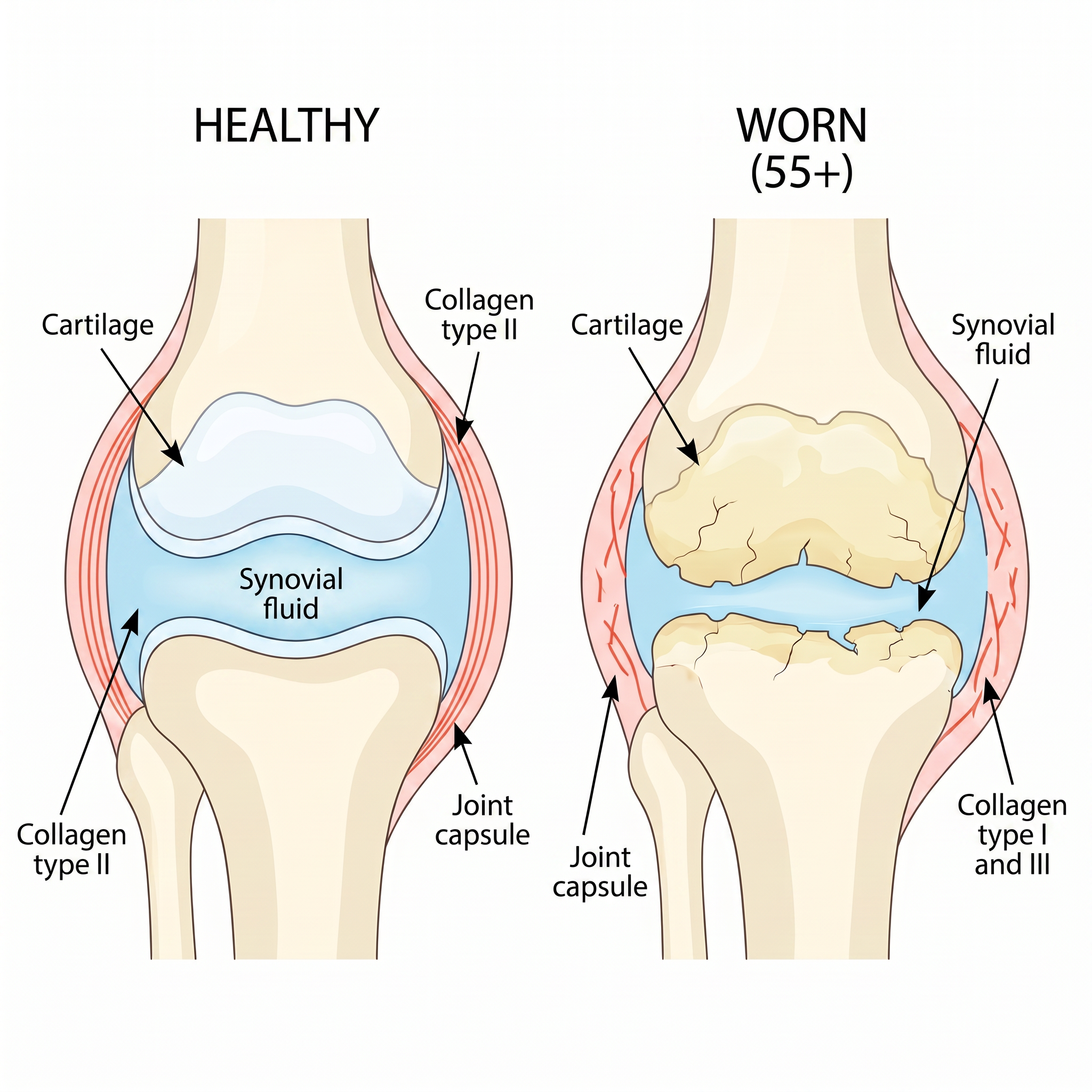
- Articular cartilage, the smooth layer on the ends of the bones, is a matrix of type II collagen and proteoglycans holding water.
- The menisci, the two shock absorbing wedges, are largely type I collagen.
- The ligaments and the joint capsule that hold the joint stable are dense type I and III collagen.
- The patellar tendon, the structure that takes the load every time you go down a step, is type I collagen.
Every one of those is soft tissue. On a standard X-ray they are effectively invisible. The radiologist can infer cartilage loss indirectly, from how much the gap between the bones has closed, but that only becomes visible once a large amount of cartilage is already gone.
> So the report is honest and unhelpful at the same time. "Normal for your age" means "the bones look like the bones of someone your age". It says nothing at all about the collagen.
Why the collagen goes first, and why it accelerates after 40
Collagen is not a supplement ingredient first. It is a structural protein, the most abundant one in the human body, and it is what connective tissue is built from. Roughly 70 to 80% of the structures inside a joint are collagen.
Your body is constantly breaking old collagen down and building new collagen to replace it. In your twenties and thirties those two processes are balanced. Then two things change.
Oestrogen stops protecting the balance
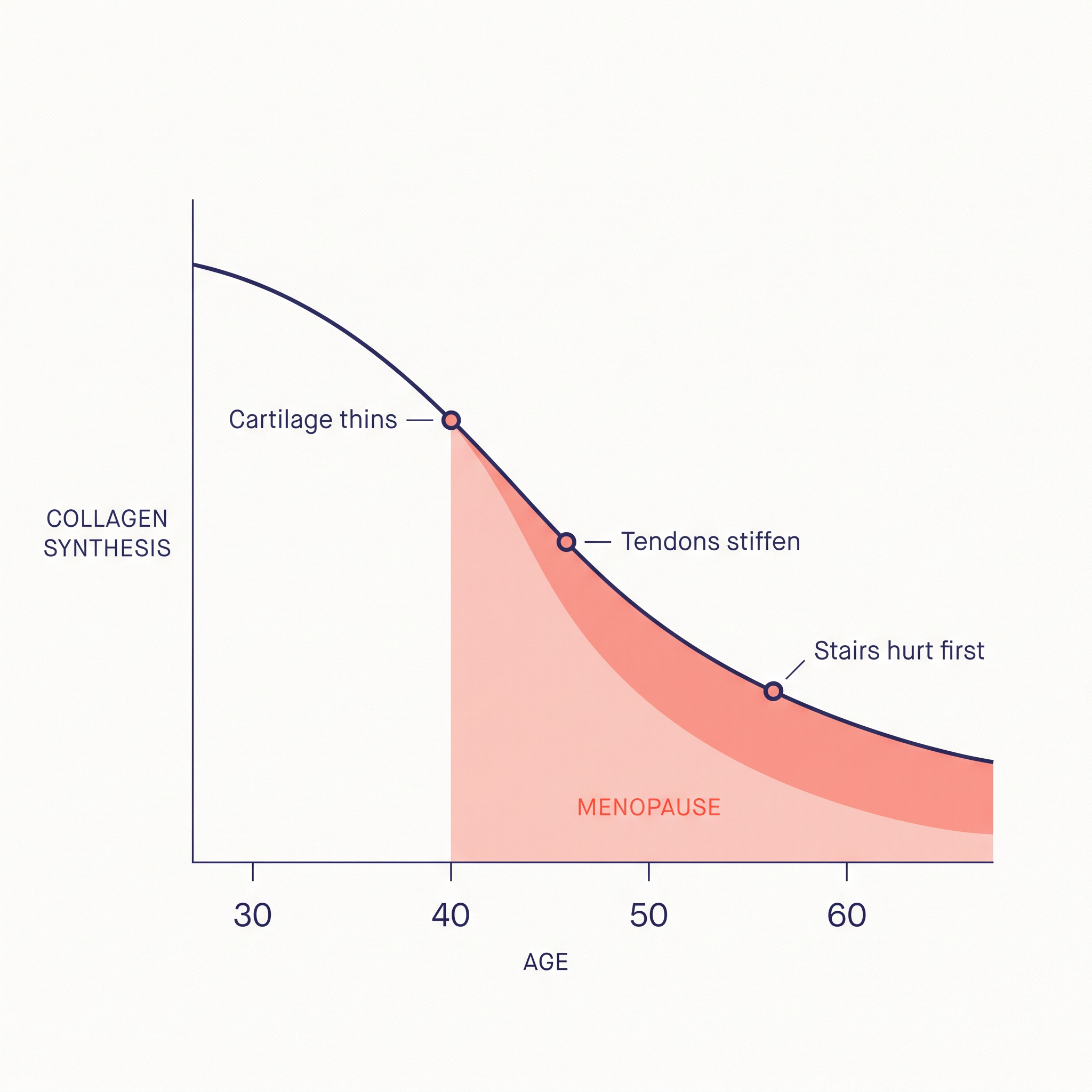
Oestrogen regulates the enzymes that control collagen turnover. Matrix metalloproteinases (MMPs) break collagen down; tissue inhibitors (TIMPs) hold them back. When oestrogen falls through the mid forties, that brake comes off. MMPs become more active and collagen is degraded faster than the body replaces it.
The clearest measurements come from skin, where women lose roughly 30% of skin collagen in the first five years after menopause, driven by the same falling oestrogen and rising MMP activity. Skin, bone, tendon, ligament and cartilage all draw on the same matrix and the same hormonal signal, which is why the changes rarely stay in one place, even though joint tissue has never been measured with that precision.
Oestrogen receptors sit inside the joint itself
There are oestrogen receptors in the synovial membrane. As oestrogen drops, the synovial fluid, the lubricant inside the joint, becomes less viscous and less protective. The same step down the same staircase now generates more friction than it did five years ago, at identical body weight and identical activity.
This is also why women after 40 report joint pain and stiffness considerably more often than men of the same age. It is not a difference in stoicism. It is a difference in hormonal exposure.
The load maths of a staircase
Descending stairs is the hardest thing you routinely ask a knee to do. Going up, the muscle shortens as it contracts. Going down, the quadriceps and patellar tendon must lengthen while under load to control your descent, which is mechanically far more demanding and puts several times body weight through the joint on every step.
That is why stairs are the early warning. A joint with a thinning collagen matrix will still cope with flat walking long after it has stopped coping with a staircase. The stairs find the problem first.
> This is the piece the X-ray cannot show you. Not a broken bone. A structure that has quietly lost its building material and can no longer absorb the load it used to.
Why the usual answers do not close the gap
If the X-ray is clear, you are usually offered one of four things. Each of them is reasonable. None of them addresses a collagen deficit.
Painkillers and anti-inflammatories. They quieten the signal for a few hours. But a silenced alarm is not a stopped fire. While you feel better, the tissue carries on thinning. Taken daily there is a second cost, to the stomach.
Cortisone injections. Real relief, often for weeks or months. Cortisone controls inflammation; it does not build tissue. And the underlying problem here is precisely a shortage of building material.
Glucosamine and chondroitin capsules. The most commonly recommended supplement, and the one with the most disappointing evidence. The GAIT trial (NEJM 2006, PMID: 16495392) followed 1,583 patients with knee osteoarthritis for 24 weeks and found the combination not significantly better than placebo across the group as a whole. To be fair to it: one exploratory subgroup, those with moderate to severe pain, did respond better than placebo. That subgroup was small and the finding was never accepted as general evidence. If your knee pain is mild to moderate, you are in the part of the trial that showed no benefit.
Physiotherapy alone. Genuinely valuable, and the strength work matters. But you cannot rebuild a tendon out of movement. Loading tissue that lacks raw material can make it sorer, not stronger. Physiotherapy works far better when the material is there to build with.
Collagen capsules from the pharmacy. The right idea at the wrong dose. A typical capsule delivers 1,000 to 2,000 milligrams. The clinical literature on connective tissue works at 10 to 15 grams a day. That is five to fifteen times the difference, and it is not a gap you close by taking the capsules for longer.
> A capsule holds milligrams. A knee is short of grams.

What the research supports
Hydrolysed collagen is collagen enzymatically cut into short peptide chains of 2 to 5 kilodaltons. At that size the peptides cross the gut wall and enter the bloodstream, which has been shown with isotope labelling in controlled studies. Once circulating, specific sequences (Pro-Hyp, Hyp-Gly, Gly-Pro-Hyp) signal chondrocytes and fibroblasts in the joint to increase their own collagen production. The body receives both the raw material and the instruction.
Koenig D et al., Nutrients 2018 (PMID: 29337906). 102 postmenopausal women took 5 grams of specific collagen peptides daily for 12 months. Bone mineral density in the spine and femoral neck rose significantly against placebo, alongside the bone formation marker P1NP. Bone, cartilage, ligament and capsule share one collagen matrix, so supplying the matrix supplies all of it.
Praet SF et al., Frontiers in Nutrition 2019 (PMID: 31417498). Patients with chronic Achilles tendon problems took collagen peptides for 6 months alongside a structured calf loading programme, while the placebo group did the same exercise without the peptides. The collagen group improved significantly more on tendon imaging and reported less pain. Note what that actually says: the exercise was working in both groups, and the peptides changed how much tissue rebuilt while it was being loaded. It is the clearest evidence for the point made above, that physiotherapy works better when the raw material is there.
Clark KL et al., Current Medical Research and Opinion 2008 (PMID: 18416885). Athletes with activity related joint pain took 10 grams of hydrolysed collagen daily for 24 weeks, with a significant reduction in pain during activity and at rest against placebo. Relevant here because it shows the effect holds in people who are actively loading the joint.
The vitamin C detail that gets missed
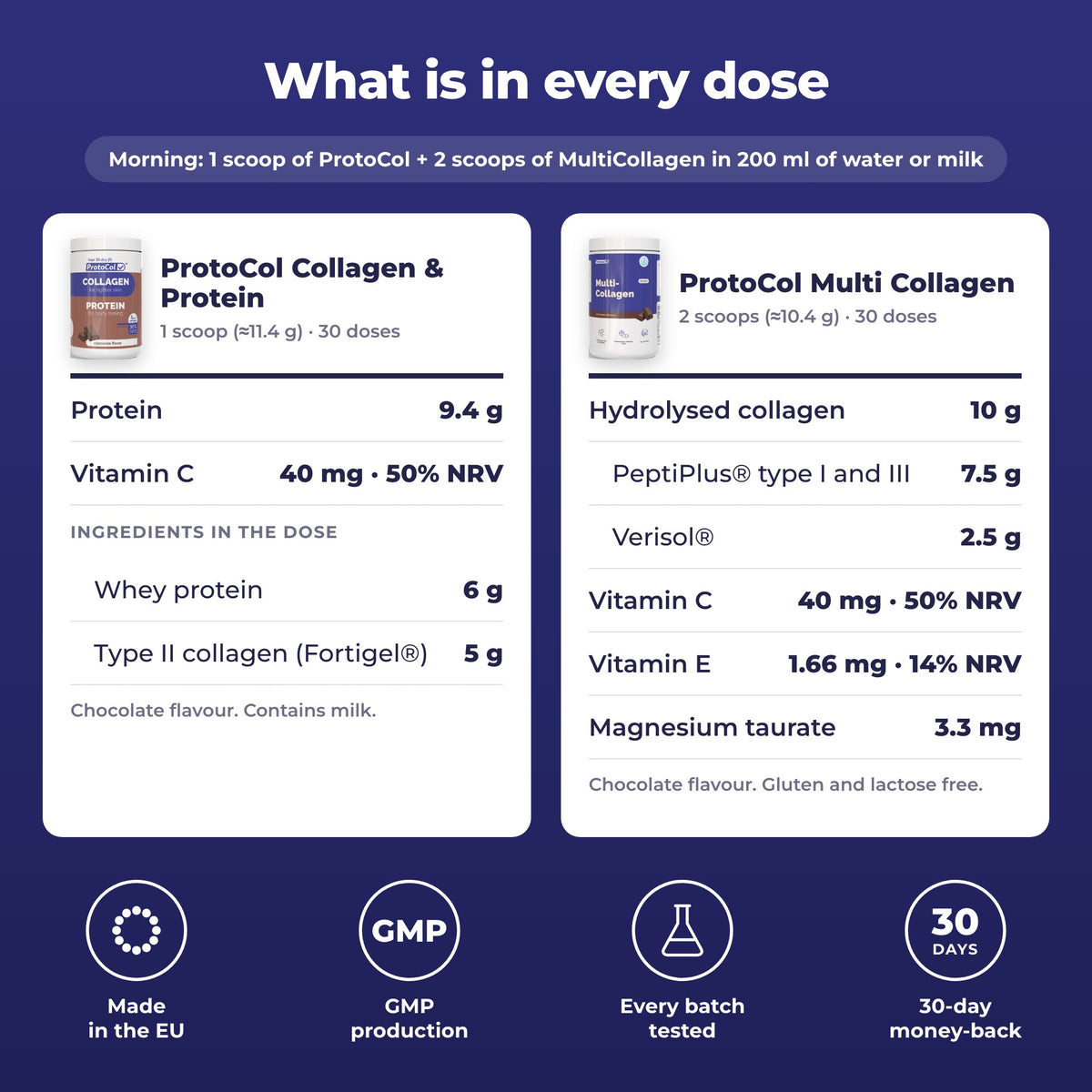
The NIH Office of Dietary Supplements lists vitamin C as a required cofactor for prolyl hydroxylase and lysyl hydroxylase. Without it, procollagen chains cannot be hydroxylated and cannot fold into a stable triple helix. You can supply all the collagen peptides you like; without vitamin C the body cannot assemble them properly. This is why both Protocol jars carry 40 mg of vitamin C per dose (50% NRV).
Why type I and III rather than pure type II
Type II is the collagen in cartilage, so taking pure type II sounds like the obvious move. In practice most serious clinical work on joints uses type I and III hydrolysate, because it is well tolerated at gram level doses and still stimulates the body's own type II production in cartilage. Pure type II is normally used at tiny doses in a completely different way, which is why the trials that matter here do not use it.
What a clinical dose looks like in practice
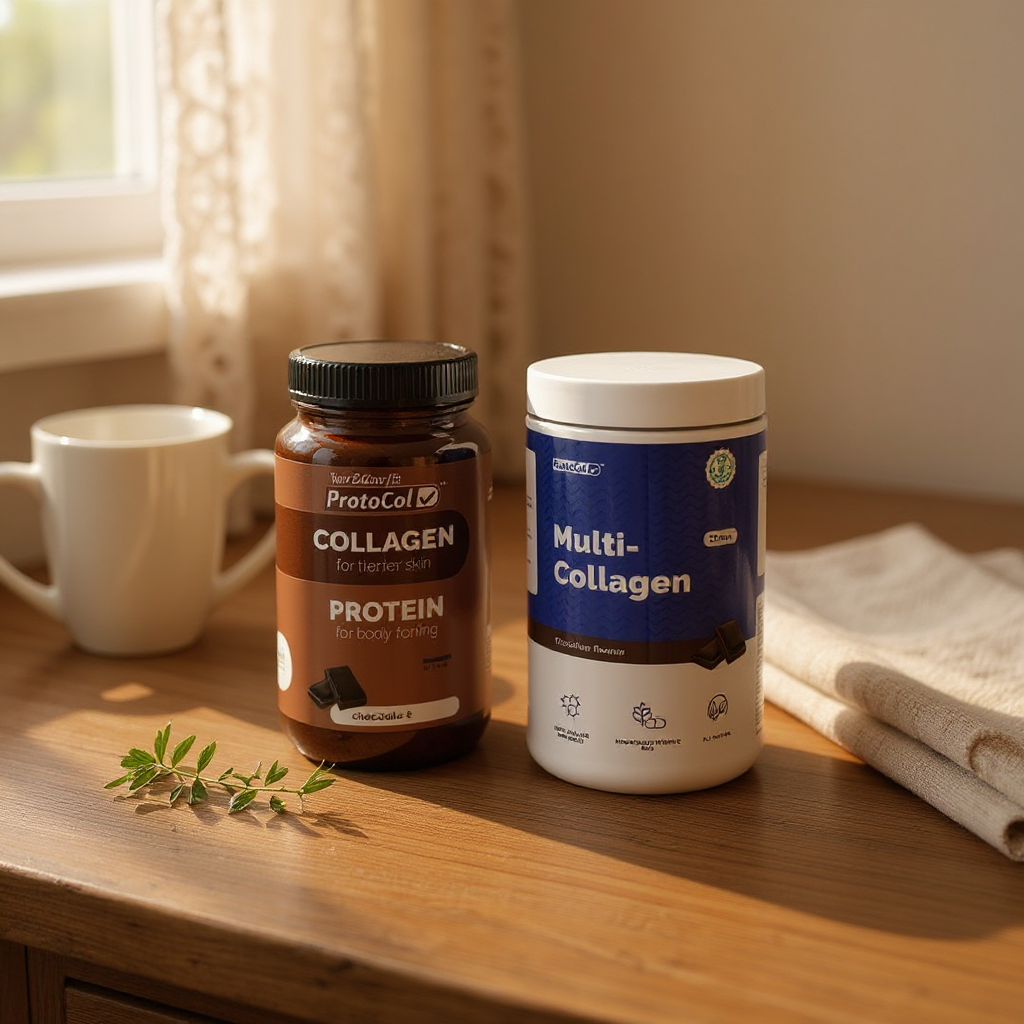
The CollagenMax Bundle is two jars because the dose does not fit in one, and because the two do different jobs.
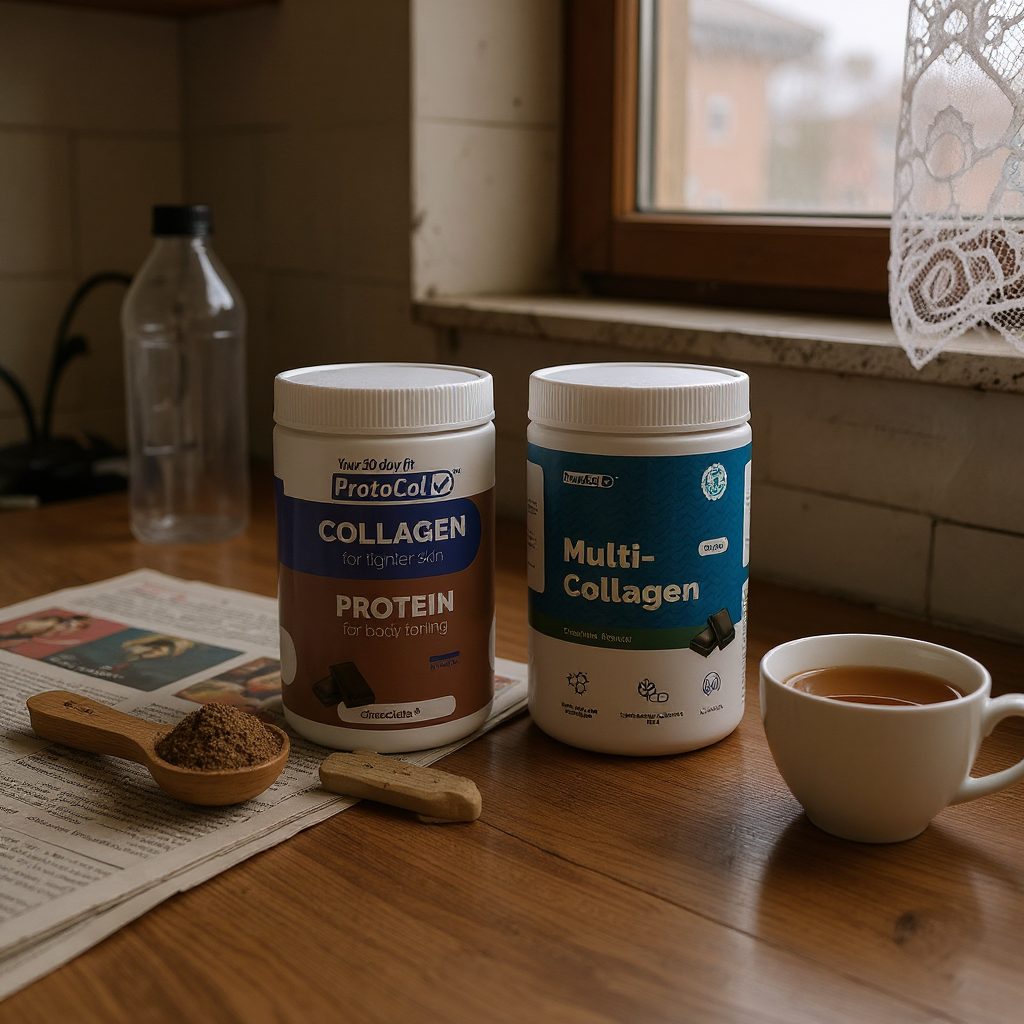
The brown jar, ProtoCol Collagen + Protein. One dose is about 11.4 g of powder delivering 11 g of total protein: 6 g whey protein plus 5 g of hydrolysed bovine type II collagen (Fortigel), with 40 mg of vitamin C. The whey matters for a knee specifically: leucine, isoleucine and valine support the muscle around the joint, and a stronger quadriceps mechanically unloads the knee on every step down.
The blue jar, MultiCollagen. One dose is about 10.4 g of powder delivering 10 g of hydrolysed collagen: 7.5 g PeptiPlus type I and III plus 2.5 g Verisol type I, with 40 mg of vitamin C, 1.66 mg of vitamin E and 3.3 mg of magnesium taurate.
Together that is 15 g of hydrolysed collagen a day, inside the range the trials use, plus 6 g of whey protein and the vitamin C cofactor. Both jars are chocolate flavoured and dissolve in water or milk in about 15 seconds. The two jars together are approximately 653 g of powder.
🎯 Taken morning and evening for a reason: collagen synthesis follows a daily rhythm, so the morning dose supplies the loaded daytime hours and the evening dose lines up with overnight tissue repair.
A realistic 12 week timeline
- Weeks 1 to 4. Nothing obvious in the knee. Some people notice sleep or nails first. This is the loading phase, and it is where most people quit too early.
- Weeks 5 to 8. Morning stiffness starts to ease. The first step out of bed stops being an event. None of the trials above puts a percentage on this point in the course, so we will not invent one.
- Weeks 9 to 12. The stairs. Less bracing on the handrail, less hesitation on the descent, less soreness afterwards.
- 30 day money back guarantee
- Made in the EU, laboratory tested
- 15 g of hydrolysed collagen a day
What other women report
I felt more energy almost as soon as I started. My knees no longer hurt going up and down the stairs, and that let me train more.
I ordered it with a lot of doubt, because I had tried several collagens before with no real effect. Here I felt the difference at the end of the second week: I go down the stairs without that clicking and catching in the knees, and in the morning I do not get up rusted.
I actually ran up the stairs a few days ago and I was shocked. Did I just run up those stairs?
I have had an old ache in my hip for years and I mostly sleep on my back because of it. Towards the end of the first month I noticed I could lie on that side again. It is not a miracle in three days, but the effect is real and it builds up.
🎯 The pattern we see repeatedly: nothing in weeks 1 to 4, something switches around weeks 5 to 7, normal life by weeks 8 to 12. That is the pace of connective tissue regeneration, not a marketing cycle.
Frequently asked questions
Why does my knee hurt if the X-ray is normal?
An X-ray images bone. It shows fractures, spurs and joint space narrowing. It does not image the collagen in cartilage, meniscus, tendon, ligament and capsule, which is what fails first after 40. A knee can be losing collagen for years and still produce a report that reads normal.
Why is going down worse than going up?
Descending loads the knee eccentrically: the quadriceps and patellar tendon lengthen under load to control your body weight coming down, which puts several times body weight through the joint. Going up is a shorter, concentric movement. Pain that is clearly worse on the way down is a soft tissue and load tolerance pattern.
How long before I notice something?
Most people report less morning stiffness around week 4 to 6, and stair comfort between weeks 8 and 12. The published trials run 12 to 24 weeks for a reason.
Should I still see a doctor?
Yes, and keep any appointments you have. This article explains what a normal X-ray does not rule out; it does not replace an examination. See the red flags below.
Can I take it with my medication?
Collagen peptides are a protein food, not a medicine. There are no known interactions with painkillers, antihypertensives or antidiabetic drugs. If you take immunosuppressants or anticoagulants, or you are in active oncology treatment, speak to your treating doctor first.
Is it vegan?
No. Collagen is an animal structural protein, produced here from bovine collagen. There is no biologically equivalent vegan source of hydrolysed type I and III collagen.
Is there a guarantee?
Yes, a 30 day money back guarantee. If you feel no difference in the first 30 days, send the jars back, even opened, and we refund the full amount.
⚠️ When a knee needs a doctor, not a supplement
A normal X-ray rules out a lot, but not everything, and some knee symptoms need proper assessment rather than patience.
See a doctor or an emergency department if you have:
- Sudden swelling with redness and heat in the joint, especially with a fever above 38°C. This can be infection inside the joint and needs assessment the same day.
- A knee that locks or gives way unpredictably. This suggests a mechanical problem such as a meniscal tear, which imaging beyond an X-ray can show.
- Pain after a specific injury with immediate swelling, rather than pain that came on gradually.
- Calf swelling, warmth and pain on one side. That is not a knee problem and can be a clot.
- Morning stiffness lasting more than 60 minutes daily for six weeks or more, especially with several joints involved. This can indicate inflammatory arthritis and needs blood tests, not a supplement.
Collagen will not do harm alongside any of these, but it will not solve them either. If your X-ray was clear and nobody looked at anything else, it is reasonable to ask for a soft tissue assessment or a referral.
What to take from this
A normal knee X-ray answers one question: are the bones intact. It leaves the more likely question untouched, which is whether the collagen matrix holding the joint together still has enough material to do its job.
After 40, and sharply after menopause, that material runs down faster than the body replaces it. The stairs are usually where you notice, because descending is the hardest load a knee routinely carries.
You cannot supplement your way out of a torn meniscus, and nothing here replaces a proper examination. But if the scan was clear and the stairs still hurt, the gap between those two facts is where the collagen went. 15 grams a day, plus the vitamin C cofactor, over 12 weeks is the dose the research actually uses.
30 day guarantee: if you feel no difference, we refund you. We carry the risk.